
IDPMS and EDPMS Explained: What Indian Exporters Need to Do Every Month (And Why Most Don't)
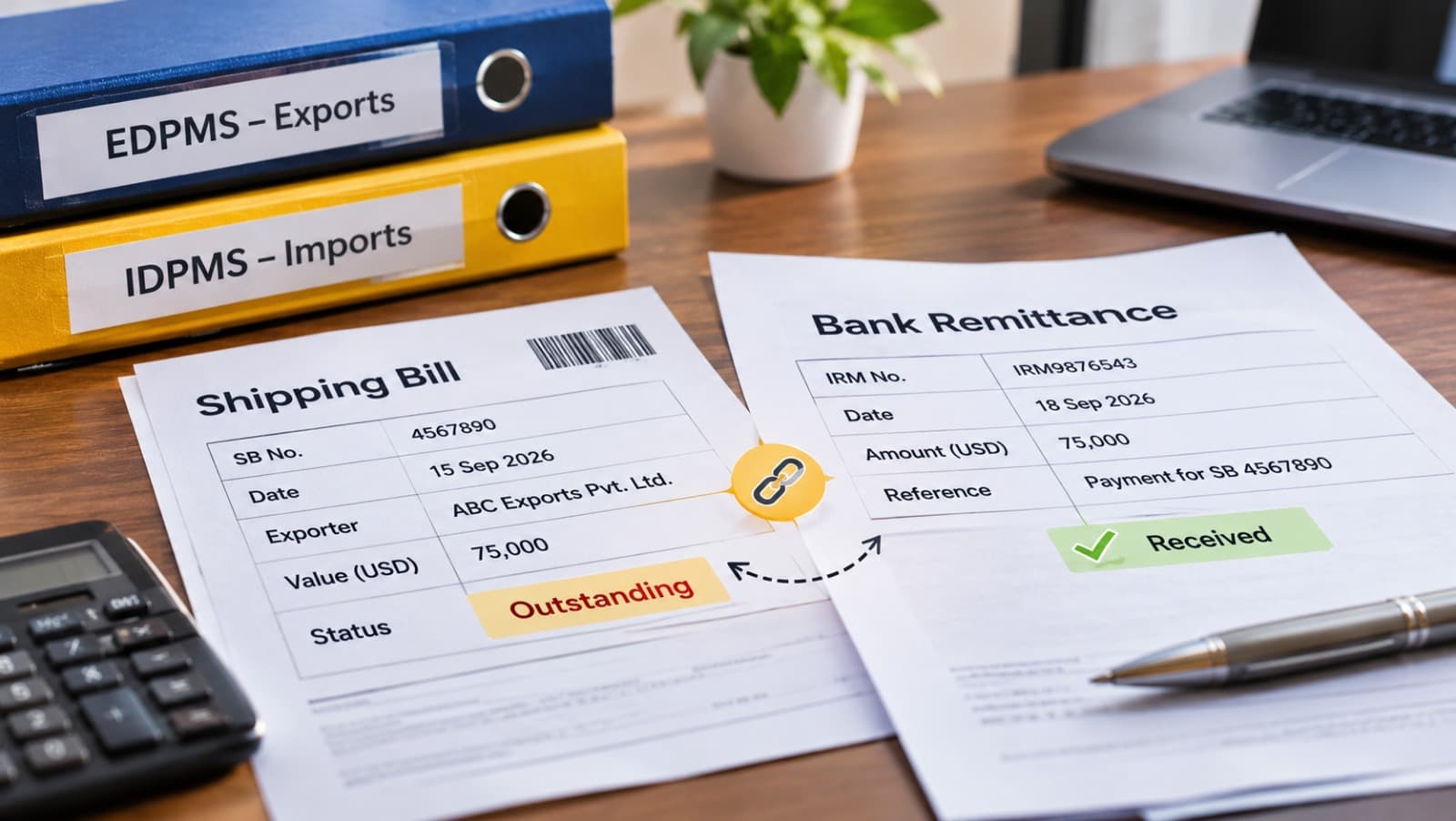
Your buyer has paid. The money is in your account. And the Shipping Bill still shows as outstanding in EDPMS because the payment was never linked to it. That's the most common reconciliation problem we see, and it's how exporters with perfectly good buyers end up with advisory notices from their bank.
Short answer: What are IDPMS and EDPMS?
EDPMS is the RBI system that tracks whether every export has been paid for. Customs reports each Shipping Bill to it, your bank reports each inward remittance, and the two have to be matched until the Shipping Bill is closed. IDPMS does the same for imports, matching each Bill of Entry with the outward payment. From 1 October 2026, export proceeds of goods must generally be realised within nine months of shipment, or twelve months for exports invoiced or settled in rupees. Entries that stay open trigger bank follow-up and, if they stay unrealised long enough, can lead to RBI caution listing.
How EDPMS and IDPMS Work for Indian Exporters, in Plain Terms
Think of each system as a ledger at the RBI with two sides. Customs writes one side, your bank writes the other, and your bank, the AD bank, is the one that marks an entry as closed once both sides agree.
EDPMS (exports) | IDPMS (imports) | |
|---|---|---|
What it tracks | Whether each export has been paid for | Whether each import has been paid for |
The customs side | Your Shipping Bill, with its declared value and currency | Your Bill of Entry |
The bank side | The inward remittance message (IRM) for each payment you receive | The outward remittance message (ORM) for each payment you make |
Who closes it | Your AD bank, once the remittance is mapped to the Shipping Bill | Your AD bank, once the payment is mapped to the Bill of Entry |
Your job | Tell the bank which Shipping Bills each receipt belongs to, and explain any differences. | Tell the bank which Bills of Entry each payment covers |
Two things in that table catch exporters out. First, matching isn't automatic. A buyer's payment arrives as an IRM with a remittance reference, not a Shipping Bill number. Unless someone tells the bank which Shipping Bills it settles, the money sits in your account and the entry stays open.
Second, most exporters also import. If you bring in raw materials or components, every Bill of Entry you file creates an IDPMS entry that needs an ORM against it. So the monthly job is usually two reconciliations, not one.
There's also a third data trail. When an export is realised, your bank's realisation data feeds the electronic Bank Realisation Certificate (eBRC) on DGFT, which DGFT relies on to confirm realisation for export incentives. An export that's paid but not reconciled can hold up that trail too.
Export Realisation Deadlines in 2026: Which Rule Applies to Your Shipment
If you've read that exporters now have 15 months to realise proceeds, that was true for a while, and it may still be true for some of your older Shipping Bills. But it isn't the rule for new shipments. The deadline now depends on when the goods were shipped.
Shipped | Realisation period | Rule |
|---|---|---|
Up to 13 November 2025 | 9 months | 2015 export regulations |
14 November 2025 to 4 June 2026 | 15 months | Relief under FEMA 23(R)/(7)/2025-RB, 13 November 2025 |
5 June 2026 to 30 September 2026 | 9 months | First Amendment, FEMA 23(R)/(8)/2026-RB, 5 June 2026 |
From 1 October 2026 | 9 months, or 12 months if invoiced or settled in rupees | 2026 Regulations as amended by FEMA 23(R)/(1)/2026-RB, 22 September 2026 |
Under the new regime, the clock for goods runs from the date of shipment, for services from the invoice date, and for goods sent to a warehouse abroad from the date they're sold from it. Your AD bank can extend the period if you give it a reason it accepts.
The practical problem is that a single exporter can now have open Shipping Bills on three different clocks. A spreadsheet with one ageing column gets this wrong.
Other changes from 1 October 2026 worth knowing
The Foreign Exchange Management (Export and Import of Goods and Services) Regulations, 2026 also changed how open entries are handled:
- EDPMS and IDPMS entries up to ₹10 lakh can be closed on your declaration of realisation or payment, with quarterly bulk declarations allowed.
- AD banks can allow invoice value reductions and close entries for under-realisation, on your request with a justification they accept. The old self write-off route has gone.
- Export receivables can be set off against import payables with the same overseas party or its group companies, within the realisation period.
- Import payments follow the contract terms rather than a fixed six-month period, and banks follow up IDPMS entries against those terms.
- Each AD bank now runs its own policy and procedure for extensions and closures, so ask yours for its 2026 operating checklist.
IDPMS and EDPMS sit alongside drawback and RoDTEP in the same post-shipment workload. Read how much duty drawback exporters leave unclaimed, or see XEMI for exporters.
Why EDPMS and IDPMS Entries Don't Match
Almost every open entry traces back to one of these.
Cause | What you see | What fixes it |
|---|---|---|
One payment covers several invoices, or one invoice is paid in parts | An IRM the bank can't map on its own | Tell the bank exactly which Shipping Bills, and how much against each |
The buyer deducted a discount, quality claim, or short shipment | Realised value lower than the Shipping Bill value | Ask the bank for a value reduction with supporting documents, or declare it if the bill is ₹10 lakh or less. |
Overseas bank charges taken from the payment | A small shortfall on every receipt | Declare the charges with the bank's advice |
The buyer paid in a different currency from the invoice | A currency mismatch the system can't match | Document the conversion and ask the bank to map it |
An advance received before shipment | An IRM with no Shipping Bill yet | Link the advance when the Shipping Bill is filed |
The Shipping Bill carries a different AD code from the bank receiving the money. | The entry sits with a bank that never sees the payment | Transfer the Shipping Bill to the right AD bank |
One common worry is less of a problem than it looks. Exchange rate movements between shipment and payment don't usually create a mismatch, because matching happens in the invoice currency, not in rupees. The trouble starts when the currency itself is different.
A worked example
A Shipping Bill is filed for $50,000. The buyer deducts $2,000 for a quality claim and pays $48,000. An intermediary bank takes $50 in charges, so $47,950 arrives as an IRM.
The bank can map $47,950 to the Shipping Bill, but $2,050 stays open. To close it, the exporter needs to get the $2,000 reduction approved with the buyer's debit note and the correspondence, and declare the $50 of bank charges. Nobody chases this in the month it happens. Six months later it's one of forty small balances, and nobody remembers the quality claim.
Want every Shipping Bill matched to its remittance as payments arrive, not at month-end? See How It Works →
What Happens When EDPMS Entries Stay Open
An open entry rarely causes trouble in the first month. It's the ones that drift past the realisation period that get expensive, and the cost lands in several places at once.
- Your bank starts asking. AD banks follow up on open entries and send advisories asking for realisation, an extension request or documents to close them. Under the 2026 framework, banks can't charge penalties for regulatory delays, but they can and do keep asking.
- Caution listing. Under RBI's existing framework, an exporter with Shipping Bills unrealised for more than two years, without an extension, can be placed on the caution list, which makes exporting on normal credit terms far harder. Listings in force on 30 September 2026 continue under the new regulations until removed.
- GST refunds paid back. If an exporter received a GST refund on exports and the proceeds aren't realised within the FEMA period, Rule 96B of the CGST Rules requires the refund to be paid back with interest, unless RBI writes off the realisation.
- Incentives clawed back. Under Rule 18 of the Drawback Rules, 2017, drawback is recovered if sale proceeds aren't realised within the FEMA period, with limited exceptions such as an RBI write-off or ECGC cover. Other incentives tied to realisation face similar recovery.
- FEMA exposure. Failing to realise export value is a FEMA contravention, and penalties under Section 13 can go up to three times the sum involved.
The cruel part is that most open entries aren't unpaid exports at all. They're paid exports that were never matched.
Got a list of open Shipping Bills from your bank? See how XEMI matches them to your remittances. Request a Demo →
The Monthly IDPMS and EDPMS Routine: Manual Versus Automated
Whatever tool you use, the monthly job has the same steps: pull the open EDPMS and IDPMS entries from your bank, list the remittances received and paid, map one to the other, chase the documents behind every difference, send the bank your mapping and requests, and track each open entry against its own deadline.
Step | Done manually | Done with post-shipment compliance software |
|---|---|---|
Getting the data | Bank statements, EDPMS reports and ICEGATE downloads, each in its own format | IRM and ORM data pulled from bank and RBI systems alongside your Shipping Bills and Bills of Entry |
Matching | Spreadsheet lookups, one remittance at a time | Matching suggested automatically, with only the exceptions left for a person |
Explaining differences | Hunting through emails for the debit note or bank advice | Differences flagged against the shipment, with its documents attached |
Telling the bank | Letters and emails, prepared by hand each month | Advisory notifications generated and sent from the same system |
Tracking deadlines | One ageing column for every Shipping Bill | Each entry tracked against the rule that applies to its shipping date |
In a manual setup, this lands on a finance team that's also closing the books. So it gets done when someone has time, which is usually after the bank's advisory has arrived.
IDPMS EDPMS Management Software India: How XEMI Handles Post-Shipment Compliance
XEMI is an AI-powered trade collaboration platform for importers, exporters, CHAs and freight forwarders. XEMI Finance, its finance and cost automation module, runs IDPMS and EDPMS reconciliation as part of the same workflow that files your Shipping Bills and Bills of Entry.
- Data from all three sides. ORM and IRM data is retrieved from bank and RBI systems and reconciled against your Bill of Entry and Shipping Bill filings, a three-way reconciliation across RBI, customs and your banks.
- Discrepancies flagged early. Every mismatch is identified against the shipment before it turns into a bank advisory.
- Advisories sent from XEMI. Advisory notifications to banks are generated and sent directly from the platform.
- eBRC and certificates of origin in one click. Filing runs through XEMI's direct DGFT API integration, and the status updates when DGFT processes it.
- A record that holds up. Every reconciliation, correction and approval is timestamped and kept with the shipment for seven years and more, ready for an RBI inquiry or audit.
70 to 80% less team time per job
That's the reduction XEMI customers see in time spent per job, which is what frees a finance team to reconcile every month instead of every quarter.
XEMI doesn't approve extensions, value reductions or write-offs. Those decisions stay with your AD bank. And if you ship only a handful of consignments a month to buyers who pay in full, a careful spreadsheet may be enough for now.
Finance team stretched every month-end? See three-way reconciliation running on your own data. Request a Demo →
FAQ
Frequently asked questions
What is the difference between IDPMS and EDPMS?
EDPMS tracks exports, matching each Shipping Bill to the inward remittances received for it. IDPMS tracks imports, matching each Bill of Entry to the outward payments made for it. Both are RBI systems updated by customs and your AD bank.What is the export realisation period in India in 2026?
For goods shipped from 1 October 2026, nine months from shipment, or twelve months if the export is invoiced or settled in rupees. Shipments from 14 November 2025 to 4 June 2026 keep the fifteen-month period that applied when they were made.Why is my Shipping Bill still open in EDPMS when the buyer has paid?
Usually because the payment hasn't been mapped to it. The bank receives an inward remittance with a reference number, and until you tell it which Shipping Bills the payment covers, the entry stays open.Can small EDPMS entries be closed without bank documents?
Yes. From 1 October 2026, entries up to ₹10 lakh can be closed on your declaration of realisation or payment, and declarations can be submitted quarterly in bulk.What happens if export proceeds aren't realised in time?
Your bank will follow up, drawback and GST refunds tied to realisation can be recovered with interest, and Shipping Bills unrealised for more than two years can lead to RBI caution listing.What does export compliance management software do for EDPMS?
It pulls remittance data from your bank alongside your Shipping Bills, suggests the matches, flags differences and sends the bank what it needs to close each entry. XEMI also handles eBRC filing through its DGFT API integration, so post-shipment and DGFT compliance sit in one workflow.