
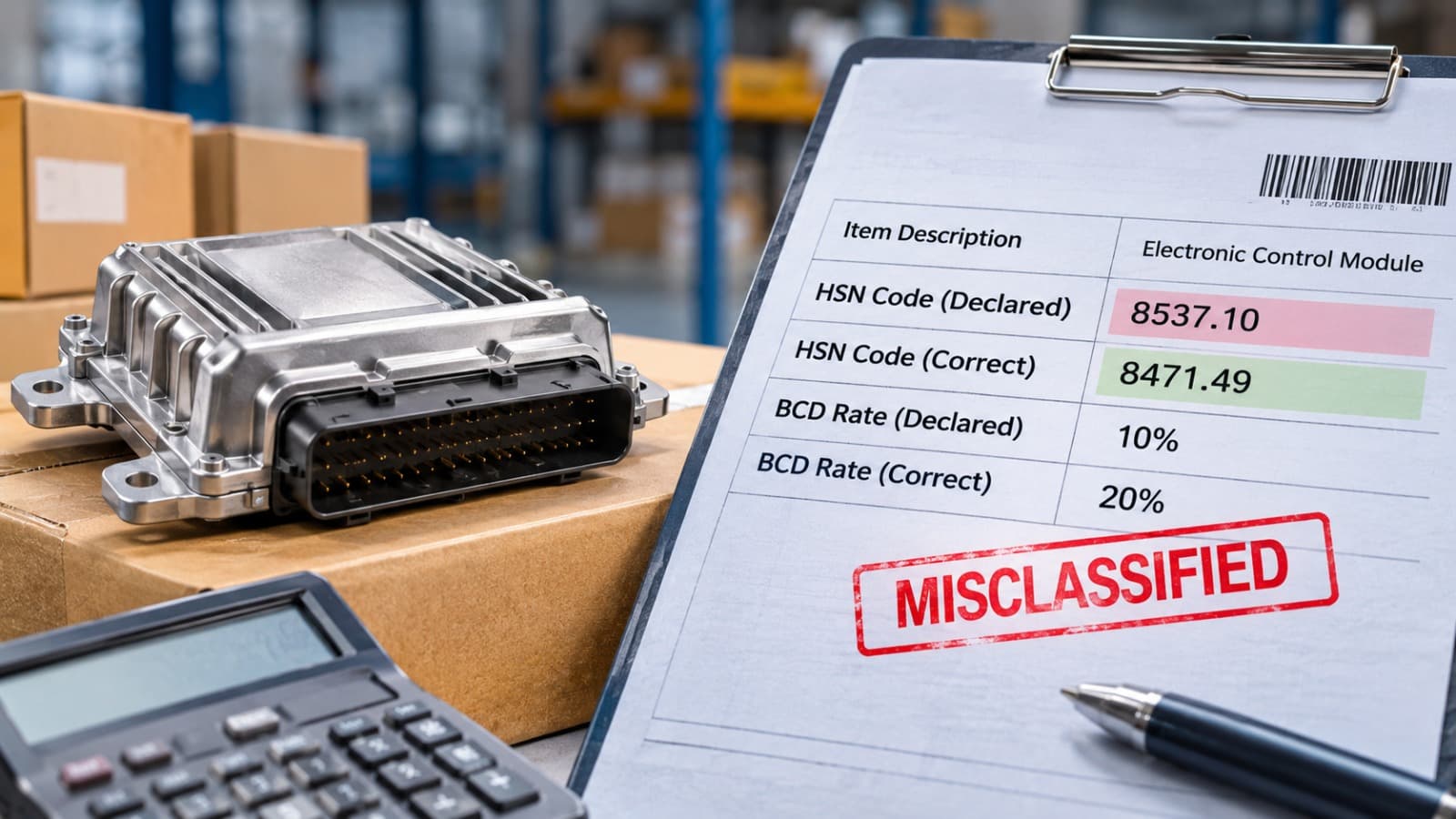
The Real Cost of HSN Misclassification: How One Wrong Code Can Cost More Than a Year of Compliance Software
A wrong HSN code is almost never caught on the first Bill of Entry. Most go through facilitated clearance on your self-assessment. It's caught on the twentieth, or in an audit two years later, by which point the same code has gone through on every shipment of that product.
Short answer: What does HSN misclassification cost in India?
If you've underpaid duty because of a wrong HSN code, customs can demand the differential duty for up to two years, or five years where there's wilful misstatement or suppression, plus interest at 15% per annum under Section 28AA. In wilful cases, Section 114A adds a penalty equal to the duty, cut to 25% if paid within 30 days of the order. Goods held for examination run up demurrage, differential IGST paid later may not be claimable as input credit, and exporters can lose RoDTEP and drawback on wrongly coded Shipping Bills. Overclassification costs money too, as duty paid that was never owed.
HSN Misclassification and the Customs Act: Demand, Interest and Penalty in India
The cost depends heavily on one question: was the wrong code an honest mistake, or does customs say it was wilful? Here's what the law allows in each case.
Provision | What it does | How much |
|---|---|---|
Lets customs demand duty that was short-levied | Up to 2 years back in normal cases, 5 years where there's collusion, wilful misstatement or suppression | |
Section 28AA | Interest on the unpaid duty | 15% a year, from the date the duty was due |
Penalty for improper import of dutiable goods | Up to 10% of the duty evaded or ₹5,000, whichever is higher | |
Penalty where duty was short-levied through collusion, wilful misstatement or suppression | Equal to the duty, cut to 25% if duty, interest and penalty are paid within 30 days of the order | |
Penalty for knowingly using a false or incorrect declaration or document | Up to five times the value of the goods | |
Section 111(m) | Confiscation of goods that don't match the Bill of Entry | Goods can usually be redeemed on payment of a fine |
What you can still control after the error is found
In a normal case, paying the duty and interest before a notice, or within 30 days of receiving one, means no penalty and the matter closes. Where customs alleges wilful misstatement, Section 28(5) lets you close it by paying the duty, interest and a penalty of 15% of the duty within 30 days of the notice.
One correction to a figure you'll often see quoted. The penalty of up to three times the value comes from Section 114, and it applies to prohibited goods being exported improperly. It isn't the penalty for a classification error on an import.
And a fair warning. Many classification disputes are genuine differences of opinion, and tribunals regularly refuse penalties where the importer declared the goods honestly. But you only get to argue that after the demand, the interest and the legal fees have arrived.
Read more on AI in HSN code classification, or see XEMI for importers.
The Cost of One Wrong HSN Code: A Worked Example
Take an illustrative importer of an electronic control module. Its Bill of Entry uses a tariff item with 10% BCD. The correct item carries 20% BCD. IGST is 18% either way. It brings in 24 shipments a year, each with an assessable value of ₹50 lakh.
Step 1: The duty shortfall builds up quietly
Per shipment | How it's calculated | Amount |
|---|---|---|
Extra BCD | 10% more on ₹50 lakh | ₹5,00,000 |
Extra SWS | 10% of the extra BCD | ₹50,000 |
Extra IGST | 18% of the extra BCD and SWS | ₹99,000 |
Shortfall per shipment | ₹6,49,000 | |
Shortfall over 24 shipments | ₹1,55,76,000 |
Step 2: Interest runs from the day each duty was due
At 15% a year, if the average shipment's duty has been outstanding for 18 months when the demand arrives, interest adds about ₹35.05 lakh.
Step 3: The penalty depends on intent
Scenario | What's paid | Total |
|---|---|---|
Honest error, paid within 30 days of the notice | Duty + interest, no penalty | About ₹1.91 crore |
Wilful misstatement alleged, paid within 30 days of the order | Duty + interest + 25% of a 114A penalty (₹38.94 lakh) | About ₹2.30 crore |
Wilful misstatement, penalty contested and lost | Duty + interest + 114A penalty equal to the duty (₹1.56 crore) | About ₹3.47 crore |
Step 4: The shipment that got held
The discovery usually starts with one Bill of Entry sent for examination. Say two 40-foot containers sit four days beyond their free time while it's sorted out. On a tariff like Emirates Shipping Line's 2026 India schedule, at $145 a day per container, that's $1,160, roughly ₹1 lakh, before CFS storage, the production line waiting for parts and the time your team spends on it.
Step 5: The credit you may not get back
Of the ₹1.56 crore shortfall, ₹23.76 lakh is IGST. You'd expect to claim it back as input tax credit. The next section explains why that isn't guaranteed.
All of this from one tariff item on one product. These figures are illustrative, so run the same steps with your own rates and volumes.
Beyond Customs: How a Wrong HSN Code Hits IGST Credit and Export Incentives
The IGST you assumed would come back
IGST paid on a Bill of Entry normally comes back as input tax credit. Differential IGST paid later, after customs raises a demand, is a different matter.
In a November 2025 ruling, Gujarat's Authority for Advance Ruling looked at an importer whose machines had been reclassified, with IGST rising from 5% to 18%. The importer paid about ₹27 lakh of differential IGST by challan. The authority held that neither the customs letter nor the challan is a prescribed document for claiming input tax credit, so the credit was denied. Advance rulings bind only the applicant, but the reasoning is a clear warning.
In our example, that would turn ₹23.76 lakh of IGST from a timing difference into a permanent cost.
There's a quieter risk too. When the HSN code on your Bills of Entry differs from the one in your own GST returns for the same goods, it hands both departments an inconsistency to ask about.
The export side: RoDTEP and drawback
For exporters, the HSN code on the Shipping Bill decides the incentive rate. RoDTEP rates are notified against 8-digit tariff lines, and drawback rates against tariff items in the drawback schedule. Use the wrong code and you either claim a rate you weren't entitled to, which customs can recover with interest, or miss one you were.
Customs does recover excess incentives. When a wrong exchange rate was applied to Shipping Bills in 2023, the department directed exporters to reverse the excess drawback, RoSCTL and RoDTEP with interest. Excess claimed under a wrong tariff code can be recovered the same way. The same code also has to match the certificate of origin, or your buyer loses an FTA rate at the other end.
The Other Side of HSN Misclassification: Duty You Never Owed
Not every wrong code underpays. Plenty of importers use a code with a higher rate than they need, or miss an exemption or FTA rate that applies to the correct one. Nobody sends a notice about that. The money just goes.
"XEMI flagged that we'd been using an incorrect HS code for over eight months. The duty recalculation showed we'd overpaid by more than AED 180,000."
Head of Trade Compliance, Consumer Electronics Importer, Dubai
Getting overpaid duty back in India takes effort and a deadline. Refund claims are generally due within one year of paying the duty, and a self-assessed Bill of Entry has to be corrected before a refund can follow. Since 1 November 2025, a voluntary revision under Section 18A can double as the refund application, which makes this much simpler. But you can only claim what you've noticed.
₹12 Cr+ in duty overpayments recovered
That's what XEMI customers recovered in their first year, from errors like wrong codes and missed duty rates.
Want to know whether your current codes are costing you in either direction? See How It Works →
Why HSN Misclassification Happens, and How to Prevent It
In almost every import operation we work with, wrong codes come from the same few places:
- The code is entered from memory or copied from the last job. It was right once, for a different model.
- The supplier's code is used as is. It's often only 6 digits, or follows the origin country's tariff, not India's.
- The tariff moved and the item master didn't. From 1 May 2026, Budget 2026 tariffisation created new tariff items in several chapters.
- The ERP, the invoice and the CHA's filing each hold a different code, and nobody reconciles them.
- The product is genuinely hard to classify, and the decision was never written down with its reasoning.
The fixes are mostly discipline. Keep one approved code per product, with the reason recorded. Check it against the current tariff and its compliance requirements before every new product or model. Review your highest-duty items every year. For a high-value product that's genuinely ambiguous, an advance ruling from the Customs Authority for Advance Rulings gives you a binding answer. And if you find a past error, a Section 18A revision lets you correct it with interest and no penalty, as long as customs hasn't started an audit or investigation.
HSN Code Classification Software: How XEMI's HSN 360 Catches the Wrong Code Before It Repeats
Discipline is hard to keep across hundreds of products and thousands of Bills of Entry. That's the job XEMI, an AI-powered trade collaboration platform for importers, exporters, CHAs and freight forwarders, takes on with HSN 360.
- A recommended code with a confidence score. HSN 360 recommends the HSN code for each product line from historical filing data and live tariff schedules, so an uncertain code is flagged for a human decision instead of filed by habit.
- What comes with the code. Each recommendation shows the applicable CCR, required declarations and current import policy, so a code change that brings in BIS or a licence is visible before filing.
- Alerts when the tariff moves. When a code is updated or reclassified, XEMI alerts you.
- The same code everywhere. XI, XEMI Intelligence, cross-checks the code on the invoice, packing list, certificate of origin and Bill of Entry or Shipping Bill before anything is filed.
- An audit trail for every decision. Every classification is recorded against the shipment, with documents kept in XEMI Vault for seven years.
100% customs audit pass rate
That's what XEMI customers report in their first year on the platform.
HSN 360 doesn't replace your classification expert or a formal advance ruling on a difficult product. It makes sure their decisions are applied the same way on every shipment, and that the uncertain ones reach them in the first place.
Head of Trade Compliance? See HSN 360 check your own products against the current tariff. Request a Demo →
FAQ
Frequently asked questions
What is the penalty for wrong HSN classification in customs in India?
It depends on intent. For an honest error, you pay the differential duty with 15% interest, and no penalty if you pay within 30 days of the notice. Where customs proves wilful misstatement or suppression, Section 114A adds a penalty equal to the duty, reduced to 25% if paid within 30 days of the order.How far back can customs demand duty for a wrong HSN code?
Two years in normal cases, and five years where there's collusion, wilful misstatement or suppression of facts, under Section 28 of the Customs Act.Is the penalty for misclassification three times the duty?
No. The three-times figure comes from Section 114, which covers improper export of prohibited goods and is based on the value of the goods. For a classification error on an import, the relevant penalties are under Sections 112 and 114A.Can I claim input tax credit on differential IGST paid after a customs demand?
Not reliably. In a November 2025 ruling, Gujarat's Authority for Advance Ruling held that a customs letter and payment challan aren't valid documents for claiming credit on differential IGST. Get specific advice before counting on it.What if I've been paying too much duty because of a wrong code?
Correct the Bill of Entry and claim a refund, generally within one year of payment. Since November 2025, a voluntary revision under Section 18A can serve as the refund application.How do I prevent HSN misclassification?
Keep one approved code per product with its reasoning, check it against the current tariff before each new product or model, review high-duty items every year, and use an advance ruling for genuinely ambiguous goods. HSN code classification software such as XEMI's HSN 360 applies those checks on every shipment. Running a CHA firm? See how classification checks run on every job, for every client, before filing. Request a Demo →